
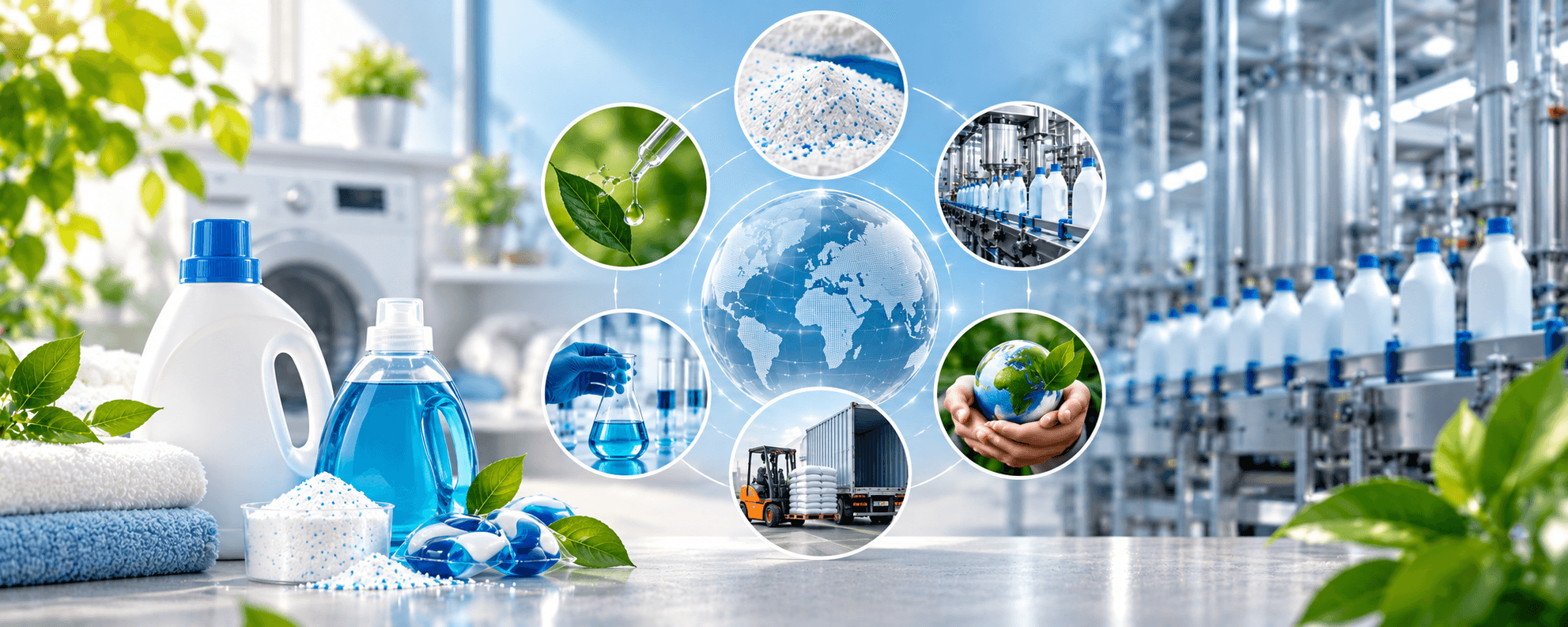

Home Detergent Chemicals Overview
The detergent industry is a fundamental part of modern daily life and industrial operations. From household laundry powders and dishwashing liquids to institutional cleaners and industrial degreasers, detergent products are designed to remove dirt, grease, stains, and unwanted residues efficiently across a wide range of cleaning conditions. As hygiene standards continue to rise in both domestic and commercial environments, detergents remain essential materials for maintaining cleanliness, safety, appearance, and operational performance.
Unlike traditional soap, detergents are formulated to perform more consistently in different water conditions, including hard water systems that contain calcium and magnesium ions. This improved performance is made possible by combining surfactants with builders, enzymes, pH regulators, solvents, fragrances, preservatives, and other specialty additives. Together, these ingredients help detergents lift soils from surfaces, suspend particles in water, reduce redeposition, improve rinsing, and deliver a more stable and repeatable cleaning result.
Today, the detergent industry is closely linked to broader trends in sustainability, product concentration, formulation efficiency, and user safety. Manufacturers are developing products that clean effectively while reducing water consumption, packaging waste, and environmental impact. This includes the growing use of biodegradable surfactants, phosphate-free systems, low-foam formulations for high-efficiency machines, and concentrated liquid or capsule-based products that offer strong cleaning power with lower transport and storage burdens.
| Aspect | Detergents | Traditional Soap |
|---|---|---|
| Cleaning Performance | Highly effective against grease, stains, and suspended soils | Effective for general washing but may have lower performance in some applications |
| Water Compatibility | Performs well in both soft and hard water | Can form soap scum in hard water |
| Formulation Complexity | Uses multiple functional ingredients for specific performance targets | Usually based on fatty acid salts with simpler composition |
| Industrial Suitability | Widely used in household, institutional, and industrial cleaning systems | More limited in high-performance technical cleaning applications |
At the heart of every detergent formulation is the surfactant system. Surfactants are the main cleaning agents that reduce the surface tension of water, allowing it to wet surfaces more effectively and penetrate oily or particulate soils. They also help loosen dirt from fabrics, dishes, floors, or industrial surfaces so that the soil can be suspended and removed during rinsing. Different types of surfactants are selected depending on the cleaning target, desired foam level, formulation stability, and end-use environment.
Anionic surfactants are among the most widely used in detergent formulations due to their strong cleaning and foaming performance. Materials such as Linear Alkylbenzene Sulfonate (LAS) and Sodium Lauryl Ether Sulfate (SLES) are commonly used in laundry detergents, dishwashing products, and all-purpose cleaners. Nonionic surfactants are often included to improve grease removal, low-temperature washing performance, and compatibility in liquid systems. Amphoteric and cationic surfactants may also be used in specialty products where mildness, disinfection support, or conditioning effects are required.
In addition to surfactants, detergent formulations rely on several other functional components to enhance cleaning efficiency and product stability. Builders help soften water and improve surfactant performance by binding minerals that interfere with cleaning. Enzymes break down protein-, starch-, and fat-based stains, making them particularly valuable in laundry applications. Bleaching agents support stain removal and whitening, while anti-redeposition agents help keep loosened soil from settling back onto the cleaned surface. Fragrances, dyes, preservatives, solvents, and rheology modifiers are also used to improve product appeal, shelf stability, and handling characteristics.
| Component | Main Role | Typical Use |
|---|---|---|
| Surfactants | Remove dirt, grease, and oily residues | Laundry detergents, dishwashing liquids, surface cleaners |
| Builders | Improve cleaning by softening water and stabilizing performance | Powder detergents, industrial cleaners |
| Enzymes | Break down complex stains such as protein, starch, and fats | Laundry and specialty stain-removal products |
| Bleaching Agents | Support whitening and oxidation-based stain removal | Laundry detergents and heavy-duty cleaners |
| Fragrances and Additives | Improve user experience, shelf stability, and formulation balance | Household and personal cleaning systems |
The selection and balance of these components determine the final product performance. A detergent intended for hand dishwashing will prioritize grease cutting and foaming profile, while an industrial machine-cleaning product may prioritize low-foam behavior, soil suspension, and chemical stability under more demanding process conditions.
Detergent production involves a combination of chemical preparation, controlled blending, and quality assurance to deliver consistent cleaning performance. The exact process varies depending on whether the final product is a powder, liquid, gel, tablet, or capsule. Despite these differences, most detergent manufacturing systems follow the same general objective: combining active cleaning ingredients and supporting additives into a stable formulation that performs reliably in the intended application.
For powder detergents, raw materials are often pre-blended and then processed through slurry preparation and spray drying. This creates a dry base powder that can later be post-dosed with heat-sensitive ingredients such as enzymes, fragrance, and specialty additives. Powder production is widely used for laundry products that require good storage stability, strong builder systems, and cost-efficient large-scale manufacturing. Particle size control, moisture balance, and bulk density are important considerations in this process.
For liquid detergents, manufacturing is generally based on sequential mixing under controlled temperature and agitation conditions. Surfactants, builders, solvents, preservatives, pH regulators, fragrances, and dyes are added in a carefully planned order to maintain clarity, viscosity, and homogeneity. Liquid systems are especially popular in household cleaning due to their convenience, ease of dosing, and strong compatibility with concentrated or multifunctional formulations.
Quality control is an essential part of detergent manufacturing. Producers routinely monitor pH, active matter content, viscosity, density, foam characteristics, stability, and cleaning performance. Depending on the application, additional testing may include stain removal trials, storage stability evaluation, low-temperature performance, compatibility with packaging, and microbiological assessment for water-based systems.
Detergents serve a broad range of cleaning needs across household, commercial, institutional, and industrial markets. In household applications, they are used in laundry care, dishwashing, kitchen sanitation, bathroom cleaning, and general surface maintenance. These products are expected to deliver strong cleaning while remaining easy to use, aesthetically appealing, and compatible with modern appliances and materials.
In institutional settings such as hospitals, hotels, schools, and food service facilities, detergents support hygiene management, surface sanitation, linen care, and equipment cleanliness. In these environments, product consistency, efficiency, and safety are especially important because cleaning standards often influence operational quality, infection control, and customer experience. Detergents for institutional use may also be paired with disinfectants or formulated to meet specific material-compatibility requirements.
Industrial detergents are used in more technically demanding processes, including machinery degreasing, metal cleaning, textile washing, food plant cleaning, bottle washing, transportation maintenance, and process equipment sanitation. These formulations may require stronger alkali systems, controlled foam behavior, faster rinsing, higher soil-loading tolerance, or better compatibility with automated cleaning systems. In some cases, detergent systems are engineered for Clean-in-Place (CIP) operations or for environments where temperature, hardness, and residue control are critical.
| Segment | Main Purpose | Typical Product Forms |
|---|---|---|
| Household Cleaning | Laundry, dishwashing, bathroom and floor cleaning | Powders, liquids, gels, pods |
| Institutional Cleaning | Linen care, sanitation, surface cleaning | Concentrates, bulk liquids, specialty cleaners |
| Industrial Cleaning | Degreasing, equipment washing, process cleaning | Heavy-duty liquids, alkaline cleaners, low-foam systems |
| Personal Wash Systems | Cleansing with mildness and foaming performance | Body wash, hand wash, shampoo-based cleansers |
This wide application range is one of the reasons the detergent industry remains commercially important. Different end users require different balances of cleaning strength, foam behavior, formulation stability, material compatibility, and sustainability profile, making detergents a highly formulation-driven product category.
Proper handling and storage are important to maintain detergent quality, worker safety, and formulation stability. While many finished detergent products are designed for controlled consumer or industrial use, the individual raw materials used during manufacturing may require more specific safety precautions. Surfactants, alkaline builders, solvents, enzymes, and bleaching agents can present irritation, dust, or reactivity risks depending on the grade and concentration involved.
Storage recommendations vary according to product type. Powder detergents should generally be protected from moisture and excessive humidity to prevent caking, ingredient degradation, and poor flowability. Liquid detergents should be stored in tightly closed containers and protected from excessive heat, freezing, or direct sunlight, all of which can affect viscosity, fragrance retention, color stability, and ingredient compatibility. In production environments, storage tanks, piping, and filling systems should be selected to match the chemical properties of the product being handled.
Personnel handling detergent raw materials should follow appropriate workplace safety procedures and consult Safety Data Sheet documentation before use. This may include the use of gloves, eye protection, dust control systems, and adequate ventilation, particularly when handling powders, enzymes, corrosive materials, or concentrated cleaning actives. Good housekeeping, contamination control, and labeling discipline are also essential to maintain both workplace safety and product integrity.
| Product Type | Recommended Storage Conditions | Main Consideration |
|---|---|---|
| Powder Detergents | Cool, dry area with moisture protection | Prevent caking and ingredient degradation |
| Liquid Detergents | Sealed containers away from direct heat and sunlight | Maintain viscosity, fragrance, and stability |
| Concentrated Industrial Cleaners | Chemically compatible storage with clear labeling | Support safe handling and controlled dosing |
The detergent industry is undergoing significant transformation as environmental performance becomes a more important factor in formulation and purchasing decisions. Historically, detergent development focused primarily on cleaning strength and cost efficiency. Today, manufacturers are increasingly expected to deliver products that also support lower environmental impact, improved biodegradability, and more responsible use of water, packaging, and transport resources.
One major area of innovation is the move toward concentrated detergent systems. By reducing water content and increasing active performance per unit, concentrated liquids and pods can lower packaging usage, reduce shipping weight, and improve storage efficiency across the supply chain. Another important direction is the adoption of biodegradable surfactants and phosphate-free builder systems that help reduce environmental burden while maintaining acceptable cleaning performance.
Formulation science is also advancing through enzyme optimization, cold-water washing compatibility, and low-foam technologies for high-efficiency machines. These developments help reduce energy consumption during washing and improve product performance under more resource-efficient conditions. In parallel, brands and manufacturers are exploring refill systems, recyclable packaging, and transparent ingredient positioning to align with growing consumer and industrial demand for more sustainable cleaning solutions.
Looking ahead, the detergent market will continue to balance performance, safety, cost, and sustainability. Companies that can combine strong cleaning efficacy with responsible sourcing, efficient packaging, and environmentally conscious formulation are likely to remain highly competitive in both consumer and industrial markets.
Every food product requires the right ingredients to achieve the desired taste, texture, stability, and shelf life. At Tradeasia, we provide reliable Detergent Chemicals Asia and ingredient solutions to support your formulation, production, and supply needs.
Browse Products