Explore our network of country and industry based websites to access localized information, product offerings, and business services across our group.
Log in to start sending quotation requests for any product.
Don't have an account? Sign Up Here
Home How Will Caustic Soda Flakes Shape the Soap and Detergent Industry in 2026?
Trade Insights | Supply Chain | 08 June 2026

Introduction Caustic Soda Flakes
Global Demand Outlook for Caustic Soda Flakes in 2026
Product Profile: Caustic Soda Flakes for Soap and Detergents
Supply Chain Dynamics and Logistics Considerations
Sourcing Strategies and the Role of chemtradeasia
Conclusion
The global soap and detergents industry depends heavily on reliable access to high-purity alkalis, and caustic soda flakes remain one of the most critical inputs in this value chain. As manufacturers plan capacity, product portfolios, and regional expansions toward 2026, understanding how the supply chain of caustic soda flakes is evolving has become a strategic priority. Volatile energy prices, shifting trade flows, and tightening environmental regulations are reshaping both production and distribution patterns worldwide.
Between 2021 and 2023, global caustic soda demand was estimated in the range of 85–90 million metric tons (100% NaOH basis), with a significant portion consumed in alumina, pulp and paper, textiles, and chemicals. However, soap and detergents account for a sizeable and steadily growing share, driven by population growth, rising hygiene awareness, and urbanization, especially in Asia, Africa, and Latin America. This growth trajectory is expected to continue into 2026, with downstream formulators requiring more consistent quality, better packaging, and more resilient sourcing strategies.
This article examines the 2026 outlook for caustic soda flakes in the global soap and detergents sector, with a particular focus on product characteristics, demand trends, logistics, and the role of integrated suppliers such as chemtradeasia. It is designed for procurement managers, supply chain planners, and technical teams seeking structured, market-oriented insights to support their medium-term planning and risk management.
By 2026, global demand for caustic soda is projected to grow at a compound annual growth rate (CAGR) of roughly 3–4%, with higher growth clusters in Asia-Pacific and parts of Africa. In the soap and detergents segment, demand growth often outpaces the overall average, as hygiene products penetrate rural markets and premium formulations expand in developed economies. Many industry analyses indicate that household and industrial cleaning products will remain a resilient consumption category even in periods of macroeconomic uncertainty, supporting stable caustic soda off-take.
Geographically, Asia-Pacific is likely to retain its position as the largest consumer and producer of caustic soda flakes, led by China, India, Indonesia, and other Southeast Asian markets. Localized production in these regions benefits from integrated chlor-alkali complexes, proximity to salt and energy resources, and strong downstream manufacturing bases for soaps, detergents, textiles, and paper. Meanwhile, Europe and North America will continue to rely on a mix of domestic production and imports, with energy costs and environmental compliance influencing plant utilization rates and trade flows.
For soap and detergent manufacturers, this translates into a more competitive environment for securing stable volumes of detergent-grade caustic soda flakes. As sustainability and regulatory pressures intensify, producers are likely to favor suppliers with transparent sourcing, robust quality systems, and the ability to provide documentation on origin, production methods, and environmental performance. This trend is pushing the market toward more structured long-term contracts, diversified supplier portfolios, and closer collaboration with global partners such as chemtradeasia that can bridge regional imbalances between supply and demand.
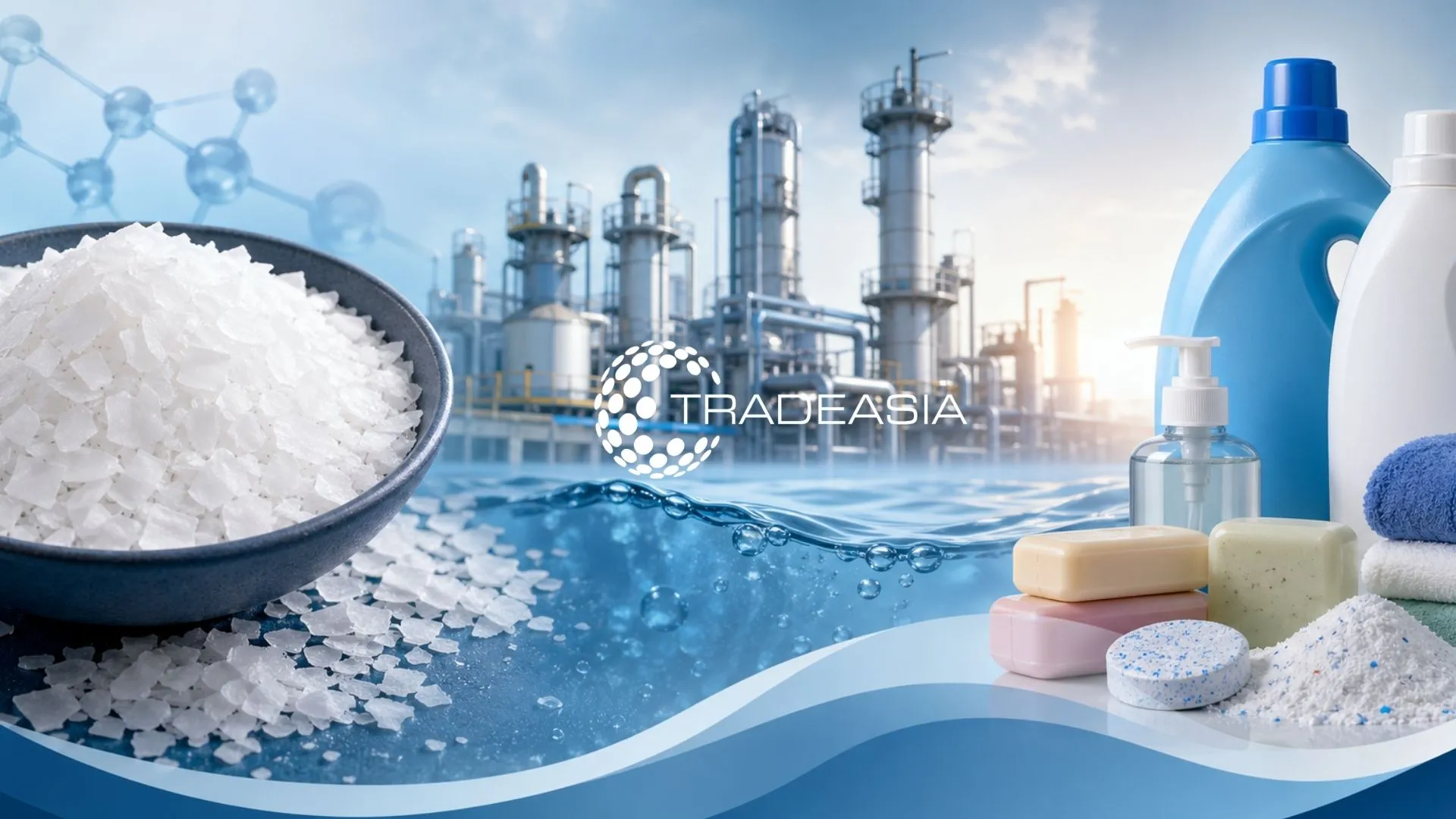
Caustic soda flakes, chemically known as sodium hydroxide (NaOH), are a solid, white, hygroscopic alkali typically produced via chlor-alkali processes and then solidified into flakes. For soap and detergent applications, common commercial purities are around 98–99% NaOH, with strict controls on impurities such as sodium chloride (NaCl), sodium carbonate (Na2CO3), iron, and heavy metals. Low impurity levels are essential to ensure consistent saponification reactions, predictable viscosity, and stable color and odor profiles in finished products.
In bar soap manufacturing, caustic soda flakes are dissolved to form a concentrated sodium hydroxide solution, which reacts with triglycerides (from tallow, palm oil, coconut oil, or other fats) in the saponification step. The quality of the alkali directly affects reaction efficiency, yield, and the physical characteristics of the soap, including hardness and foaming behavior. In liquid detergents and industrial cleaners, caustic soda is often used to control pH, enhance soil removal, and support the performance of surfactant systems. High-purity flakes are favored for easier dissolution, reduced sludge formation, and lower risk of insoluble residues in processing equipment.
Packaging formats for caustic soda flakes targeted at the soap and detergent industry typically include 25 kg or 50 kg PP/PE bags with inner liners, as well as 1-tonne jumbo bags for large-scale users. These formats must provide good moisture protection, as caustic soda is highly hygroscopic and will absorb water and carbon dioxide from the air, leading to caking and carbonate formation. Suppliers such as chemtradeasia work closely with manufacturers to match packaging, labeling, and palletization to specific plant handling systems and regional regulations, ensuring that the material arrives in a condition suitable for direct use in production.
The supply chain for caustic soda flakes is influenced by several interconnected factors: chlor-alkali production economics, energy prices, chlorine co-product demand, regional trade policies, and logistics infrastructure. Because caustic soda is co-produced with chlorine and hydrogen, operating rates at chlor-alkali plants are often driven by chlorine demand in PVC, water treatment, and other sectors. When chlorine demand softens, producers may cut output even if caustic soda demand remains strong, tightening the market and impacting availability for soap and detergent manufacturers.
Logistics is another critical dimension, especially for global movements from major producing hubs in Asia and the Middle East to consumption centers in Africa, Latin America, and parts of Europe. Caustic soda flakes are typically shipped in containerized loads, with moisture-proof packaging and careful stacking to prevent damage. Port congestion, container shortages, and rising freight rates, issues that have periodically surfaced in recent years, can significantly affect landed costs and lead times. For 2026 planning, many buyers are factoring in longer lead times, higher safety stocks, and multi-port sourcing strategies to mitigate these risks.
Regulatory and safety considerations also shape the supply chain. As a corrosive and hazardous chemical, caustic soda must comply with international transport regulations such as IMDG (for sea) and relevant local rules for storage and handling. Suppliers and logistics partners must maintain appropriate documentation, including Safety Data Sheets (SDS), hazard labels, and emergency response procedures. Integrated distributors like chemtradeasia add value by coordinating these compliance aspects across multiple jurisdictions, simplifying procurement for global and regional soap and detergent producers.
For soap and detergent manufacturers, sourcing caustic soda flakes in 2026 will require a balance between cost optimization, supply security, and quality assurance. Single-sourcing from one region or producer can expose companies to geopolitical risks, trade disruptions, or plant outages. As a result, many buyers are adopting dual- or multi-sourcing models, combining local or regional suppliers with international partners that can flex volumes depending on market conditions. This approach can smooth out price volatility and reduce the risk of production interruptions.
chemtradeasia, as a global chemical trading and distribution platform, plays a bridging role between chlor-alkali producers and soap and detergent manufacturers. By aggregating demand across multiple customers and regions, it can negotiate competitive terms with producers and offer flexible volume allocations to end-users. Additionally, chemtradeasia’s multi-origin network—spanning key production centers in Asia and beyond—allows buyers to diversify their supply base without having to manage dozens of individual supplier relationships.
Beyond pure procurement, value-added services are becoming increasingly important. These may include support with product selection (flakes versus pearls or lye, and appropriate grades), documentation management, customized packaging and labeling, and coordination of multimodal logistics from plant to factory gate. For multinational soap and detergent companies, having a partner such as chemtradeasia that understands both global market dynamics and local regulatory environments can significantly reduce administrative overhead and improve supply chain resilience, particularly in emerging markets where infrastructure and regulations may be evolving rapidly.
As the soap and detergents industry moves toward 2026, the strategic importance of caustic soda flakes in the global supply chain is becoming more pronounced. Demand growth in emerging economies, combined with evolving regulatory frameworks and sustainability expectations, is reshaping procurement priorities. Manufacturers are increasingly focused on securing consistent, high-quality alkali supplies that support efficient saponification and formulation, while also aligning with environmental and safety requirements. In this context, understanding production economics, trade flows, and logistics constraints is essential for informed decision-making.
Looking ahead, successful players in the soap and detergent value chain will likely be those who treat caustic soda sourcing as a strategic capability rather than a purely transactional purchase. This includes building diversified supplier portfolios, establishing long-term relationships with reliable partners, and investing in forecasting and inventory management tools that can handle demand and supply variability. Global distributors such as chemtradeasia can support these efforts by providing access to multiple origins, standardized quality, and integrated logistics solutions, helping manufacturers navigate a complex and dynamic market landscape.
This article is provided for informational and market insight purposes only and does not constitute technical, safety, or professional advice. Users should independently verify all information with qualified experts, consult official documentation such as MSDS/SDS and applicable regulations, or contact our team for guidance on specific applications before making procurement, handling, or operational decisions.
We're committed to your privacy. Tradeasia uses the information you provide to us to contact you about our relevant content, products, and services. For more information, check out our privacy policy.


 English
 Indonesian
 简体字
简体字
 العربية
 Español
 Français
 Português
 日本語
日本語
 한국어
한국어
 Tiếng Việt