Explore our network of country and industry based websites to access localized information, product offerings, and business services across our group.
Log in to start sending quotation requests for any product.
Don't have an account? Sign Up Here
Home How the Global SLES Supply Chain Is Shaping the Future of Cleaning Products
Trade Insights | Supply Chain | 10 June 2026

Introduction Sodium Lauryl Ether Sulphate
Global Market Outlook for SLES in 2026
Key Supply Chain Dynamics for Sodium Lauryl Ether Sulphate
Product Features, Specifications, and Applications of SLES
Sourcing Strategies and the Role of chemtradeasia
Conclusion
The global market for Sodium Lauryl Ether Sulphate (SLES) is entering a pivotal phase as we move toward 2026. As one of the most widely used anionic surfactants in soaps, shampoos, and household detergents, SLES sits at the center of the cleaning and personal care value chain. Its performance, cost-effectiveness, and extensive formulation compatibility make it a strategic raw material for multinational FMCG brands as well as regional detergent producers.
At the same time, the SLES supply chain is becoming more complex. Shifting feedstock availability, tightening environmental regulations, logistics disruptions, and evolving consumer preferences toward milder and more sustainable products all influence how producers and buyers plan their sourcing strategies. Industry participants must understand not only price trends, but also capacity developments, regional trade flows, and risk factors that can affect continuity of supply.
This article provides a structured, forward-looking view of the SLES (Sodium Lauryl Ether Sulphate) supply chain in 2026 for the global soap and detergent industry. It examines market demand, production hubs, logistics, product specifications, applications, and sourcing strategies, highlighting how professional distributors such as chemtradeasia can help manufacturers secure reliable, compliant, and competitive supplies in a rapidly evolving landscape.
Worldwide demand for Sodium Lauryl Ether Sulphate is closely tied to the growth of household and personal care products. Over the past decade, global surfactant demand has typically grown in line with or slightly above GDP, with emerging markets contributing the bulk of incremental volume. Industry analyses from leading chemical market research firms have estimated that the overall anionic surfactants market, in which SLES is a major component, has been growing at roughly 3–4% CAGR, with SLES itself benefiting from its balance of performance and cost.
By 2026, the SLES market is expected to be shaped by three main demand drivers. First, rising urbanization and income growth in Asia-Pacific, Africa, and parts of Latin America will expand consumption of laundry detergents, dishwashing liquids, and personal wash products. Second, brand owners are reformulating to meet consumer expectations for richer foam, better skin feel, and improved rinseability, all areas where SLES performs strongly when properly formulated. Third, the institutional and industrial cleaning segment, including food service, hospitality, and healthcare, is expected to maintain high hygiene standards that were reinforced during the COVID-19 pandemic, supporting steady surfactant usage.
Regionally, Asia-Pacific is projected to remain the largest and fastest-growing market for SLES by 2026, driven by China, India, Southeast Asia, and other emerging economies. Europe and North America are more mature but still important due to high per-capita consumption and the presence of major global brands. In these developed markets, growth is expected to be modest but value-driven, focusing on higher-performance and more sustainable formulations. For global buyers, this means that sourcing strategies must account for both volume growth in emerging markets and stringent regulatory and sustainability requirements in advanced economies.
The SLES supply chain begins with petrochemical or oleochemical feedstocks such as ethylene (for ethoxylation) and lauryl alcohols derived from either synthetic sources or natural oils like palm kernel oil and coconut oil. These feedstocks are ethoxylated to produce lauryl alcohol ethoxylates and then sulfated, typically using sulfur trioxide (SO₃) or chlorosulfonic acid, followed by neutralization with sodium hydroxide to yield SLES. Availability and pricing of ethylene, fatty alcohols, sulfur, and caustic soda are therefore critical cost drivers.
Production capacity for Sodium Lauryl Ether Sulphate is heavily concentrated in Asia, with significant plants in China, India, Southeast Asia, and the Middle East, complemented by capacities in Europe and North America. Producers often locate SLES plants near large detergent manufacturing clusters or ports to optimize logistics. Global trade flows typically move SLES from surplus regions in Asia and the Middle East toward demand centers in Africa, Latin America, and occasionally Europe, depending on local capacity utilization and arbitrage opportunities.
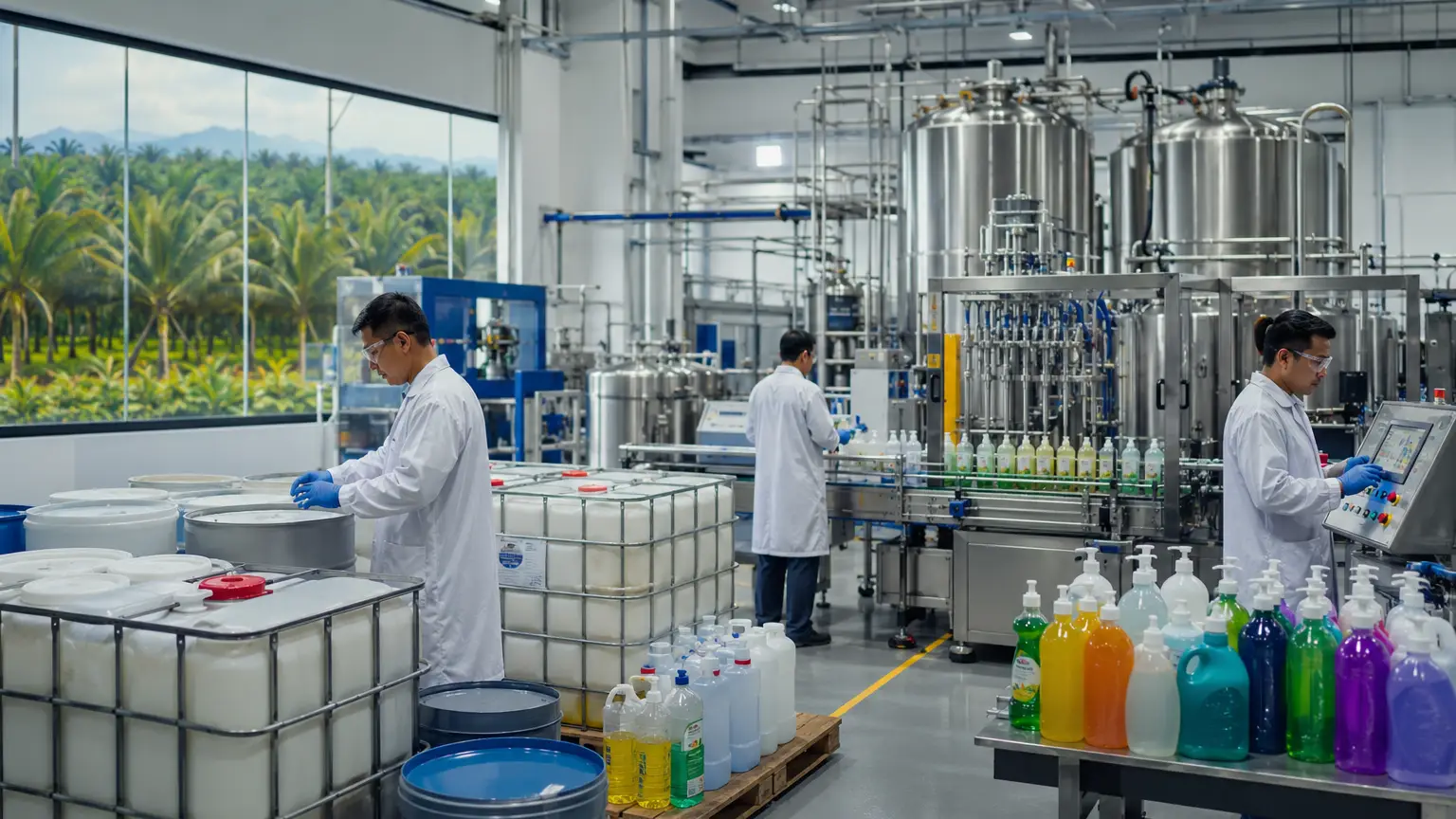
Logistics and packaging are important practical aspects of the SLES supply chain. SLES is commonly traded as a 27–70% active aqueous solution, with 70% active being a standard industrial grade for further dilution. It is shipped in bulk tankers, ISO tanks, IBCs, or drums depending on volume, distance, and infrastructure. Supply chain resilience has become a strategic concern after recent global disruptions, including port congestion, container shortages, and geopolitical tensions. As a result, many detergent manufacturers are diversifying their supplier base, qualifying multiple origins, and collaborating with distributors like chemtradeasia that can coordinate multi-region sourcing, inventory management, and flexible delivery options.
Sodium Lauryl Ether Sulphate (SLES) is an anionic surfactant typically produced with 1–3 moles of ethylene oxide, with SLES 2EO being the most common commercial grade for detergents and personal care. It is valued for its excellent foaming properties, good detergency, and relatively mild profile compared to Sodium Lauryl Sulfate (SLS). In solution, SLES appears as a viscous, clear to slightly hazy liquid, often with an active matter content of 27–70%, sodium sulfate as an impurity, and a pH usually in the range of 6.5–8.5 depending on formulation.
Key specifications for industrial buyers include active matter percentage, unsulfated matter, sodium sulfate content, color (often measured by Hazen or APHA units), and 1,4-dioxane levels, which are increasingly scrutinized by regulators and brand owners. Producers and distributors must ensure compliance with regional regulations such as REACH in Europe, TSCA in the United States, and relevant national standards elsewhere. High-quality SLES supplied through established channels like chemtradeasia is typically accompanied by detailed technical data sheets (TDS) and safety data sheets (SDS) to support formulation and regulatory compliance.
In terms of applications, SLES is a cornerstone ingredient in a wide range of products. In household cleaning, it is used in liquid laundry detergents, hand dishwashing liquids, multipurpose cleaners, and car wash formulations. In personal care, it is found in shampoos, body washes, liquid hand soaps, and facial cleansers, often blended with co-surfactants and conditioning agents to balance cleansing power and mildness. In industrial and institutional cleaning, SLES contributes to high-foaming degreasers and hard-surface cleaners. Its versatility, compatibility with other surfactants, and ability to perform across various water hardness levels make it difficult to replace entirely, even as formulators experiment with alternative or bio-based surfactants.
As the SLES market evolves toward 2026, procurement strategies for soap and detergent manufacturers are moving beyond simple price-based purchasing. Buyers increasingly evaluate suppliers on reliability, technical support, sustainability credentials, and the ability to serve multiple production sites across regions. Partnering with an experienced chemical supply chain specialist such as chemtradeasia can help companies navigate feedstock volatility, freight cost swings, and regulatory changes while maintaining continuity of supply.
chemtradeasia operates as a global platform connecting SLES producers with end users and distributors. By aggregating demand from multiple customers and coordinating supply from different producing regions, the company can help optimize logistics routes, negotiate competitive pricing, and provide flexible packaging and delivery options. For example, a regional detergent manufacturer expanding into new markets may require staged deliveries in IBCs or drums while its volumes ramp up, later transitioning to bulk shipments as scale increases. A coordinated supply chain partner can manage this transition smoothly, reducing operational complexity for the buyer.
In addition to physical supply, chemtradeasia can provide market insight and risk management support. Monitoring trends in key raw materials such as ethylene, fatty alcohols, and sulfur, as well as tracking new capacity additions or shutdowns, enables better forecasting of SLES availability and pricing. Buyers can use this information to structure contracts, diversify sourcing origins, or adjust inventory strategies. As sustainability becomes a competitive differentiator, working with suppliers and distributors that can offer SLES grades aligned with environmental and social standards, such as those linked to certified sustainable palm derivatives or reduced 1,4-dioxane content, will be increasingly important for global brands and their contract manufacturers.
The global Sodium Lauryl Ether Sulphate (SLES) market is set to remain a critical foundation of the soap and detergent industry through 2026 and beyond. Demand will be supported by population growth, urbanization, and rising hygiene standards, particularly in emerging markets. At the same time, evolving consumer expectations, regulatory tightening, and sustainability pressures will influence how SLES is produced, specified, and formulated into finished products. Manufacturers that understand these dynamics will be better positioned to maintain product performance while optimizing cost and compliance.
From a supply chain perspective, concentration of SLES capacity in Asia, volatility in petrochemical and oleochemical feedstocks, and ongoing logistics uncertainties highlight the importance of robust sourcing strategies. Building resilient supply networks, qualifying multiple grades and origins, and collaborating with knowledgeable partners such as chemtradeasia can help detergent and personal care producers secure reliable, quality-assured SLES supplies. Leveraging market intelligence, flexible logistics, and technical documentation support will be essential for navigating the increasingly interconnected global chemicals landscape.
This article is intended solely for informational and market insight purposes and does not constitute technical, safety, regulatory, or professional advice. Readers should independently verify all information with qualified experts, consult official documentation such as MSDS/SDS and relevant regulations, and contact appropriate technical or commercial teams, including ours, before making decisions regarding specific formulations, applications, or procurement strategies.
We're committed to your privacy. Tradeasia uses the information you provide to us to contact you about our relevant content, products, and services. For more information, check out our privacy policy.


 English
 Indonesian
 简体字
简体字
 العربية
 Español
 Français
 Português
 日本語
日本語
 한국어
한국어
 Tiếng Việt